How to Choose the Best Granite Ruler for Precision Work?
Choosing the best granite ruler for precision work begins with understanding the measurement environment. A granite ruler is not merely a heavy, polished bar. It is a reference tool that supports straightness checks, layout work, inspection, and fine machining decisions. Its value depends on accuracy, stability, surface quality, and proper handling.
Dr. Ted Doiron, a dimensional metrology specialist associated with NIST, has stated, “The quality of a measurement depends on the quality of the reference.” This principle deserves attention when comparing granite rulers. A ruler may look flawless under bright workshop lighting, yet small surface errors can affect a visible gap or transfer an incorrect line. Check the manufacturer’s straightness grade, calibration documentation, granite type, and working-edge finish. Black granite often provides strong visual contrast, while fine polishing helps reduce contact variation.
Size matters too. A longer ruler covers more distance, but it also requires better support. A compact ruler may be easier to control around fixtures and narrow surfaces. Weight can reduce movement, although excessive weight may make repeated handling uncomfortable. That trade-off is easy to overlook.
Inspect the tool before use. Wipe away abrasive dust. Avoid dragging it across metal. Store it on stable supports, away from sudden temperature changes. Even careful users make mistakes. I have seen accurate tools used carelessly, then blamed for inconsistent results. The ruler is only one part of the system. Operator technique, surface cleanliness, calibration frequency, and workshop temperature also deserve careful review. The right granite ruler should match the task, not simply the highest advertised accuracy.
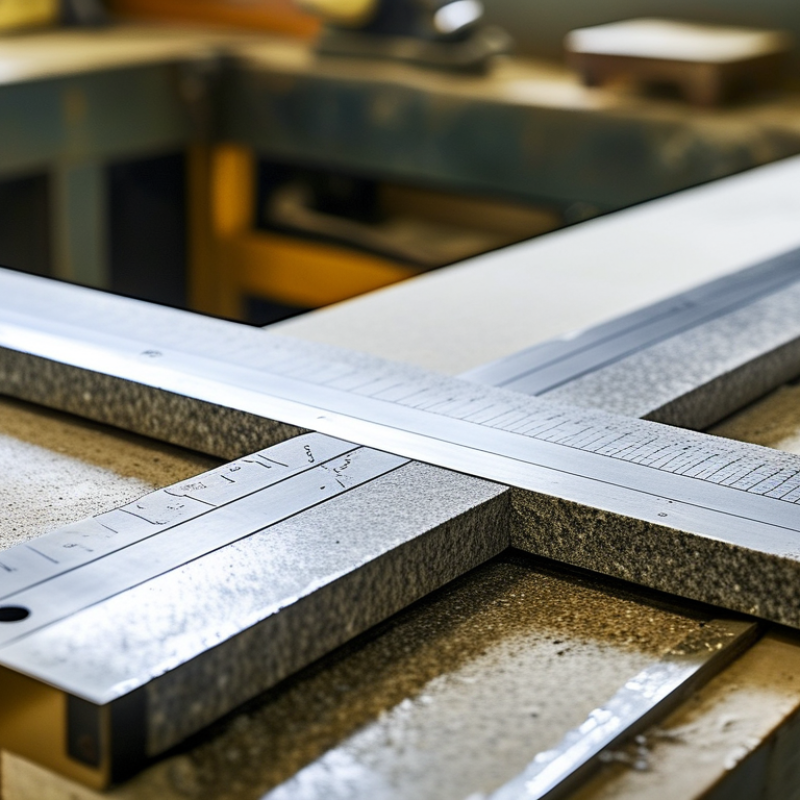
Understanding Granite Rulers and Their Role in Precision Work
A granite ruler is more than a heavy straightedge. It provides a stable reference for checking flatness, marking layouts, and inspecting machined surfaces. Granite resists rust and has low thermal expansion, so temperature changes affect it less than many metals. Its weight also reduces movement during measurement. In precision work, a clean, well-supported edge matters as much as the material itself. Dust or a small burr can create a false reading.
Choosing the best ruler requires more than comparing lengths. Check the stated accuracy, straightness tolerance, edge finish, and calibration information. A thicker ruler usually resists bending, while a shorter one may be easier to control in tight spaces. Select a length that covers the workpiece without excessive overhang. Inspect the edge under bright light. A damaged corner can ruin confidence in an otherwise accurate tool. It is easy to overtrust a certificate, though; storage and handling can change real-world performance.
Tips: Wipe the ruler before every inspection. Use lint-free cloths. Keep it on a stable surface. Avoid dragging it across granite or metal. Let the ruler and workpiece reach the same room temperature. Record unusual readings instead of forcing a perfect result. Periodic verification with a qualified reference standard helps detect wear, damage, or measurement habits that need reconsideration.
How to Choose the Best Granite Ruler for Precision Work?
Granite rulers are selected by accuracy, straightness, length, surface condition, and handling requirements. The chart below shows the estimated mass of a granite ruler with a 40 × 40 mm cross-section at common nominal lengths. It uses a representative granite density of 2.7 g/cm³; actual mass varies with stone density and geometry.
For precision inspection, choose a ruler with a certified straightness grade appropriate to the tolerance being checked. Longer rulers cover larger workpieces but are heavier and more sensitive to handling and temperature changes, so select the shortest length that fully spans the measurement area.
Matching Ruler Size and Accuracy to Your Measurement Needs
Choosing a granite ruler begins with the measurement, not the catalog. A 300 mm ruler suits small fixtures, gauge blocks, and narrow inspection tables. Larger work may require 600 mm or 1,000 mm length. However, extra length can increase handling errors. A long edge is harder to keep clean and fully supported. Measure the largest surface you inspect, then add modest working clearance.
Accuracy must match the tolerance on your drawing. If a part allows 0.05 mm variation, a ruler with 0.01 mm stated deviation may be a reasonable starting point. Confirm the complete measurement uncertainty before making that choice. For tighter work, verify straightness, parallelism, and edge condition in the calibration report. Clean surfaces matter. Dense granite resists wear, but chips and dust still matter. Wipe the contact face with a lint-free cloth before each critical check. Keep the ruler near the work area until its temperature stabilizes.
In practical use, I prefer a size one person can control without twisting. That choice reduces accidental rocking during light-gap checks. It is not always the largest ruler. I once selected a long reference edge for a compact fixture and lost time repositioning it. The decision looked efficient, but it was not. Ask how the ruler will be supported, stored, and inspected. Request traceable calibration from a competent laboratory, and record the date before relying on the result.
Choosing, Using, and Maintaining the Right Granite Ruler
Choosing the best granite ruler starts with the tolerance, workpiece size, and measuring method. A ruler for fine inspection needs a flat, stable reference edge. Select a length that spans the surface without creating awkward overhang. Longer rulers are useful, but they demand better support and careful handling.
Check the ruler’s flatness specification, edge finish, and dimensional certificate before purchase. A dense, fine-grained granite usually resists wear and temperature changes well. Still, no material stays perfect forever. Before use, wipe the ruler and work surface with a clean, lint-free cloth. Remove metal chips and dust. Even tiny particles can create false gaps.
Set the ruler gently on the reference surface. Do not drag it across the workpiece. For visual inspection, use a controlled light source and observe any continuous gap or isolated bright spot. For tighter work, feeler gauges or an approved comparison method provides better evidence. I once skipped cleaning during a quick check, and the result looked more serious than the actual error. That mistake was avoidable.
Maintain the granite ruler in a dry, stable area. Store it on firm supports that match its recommended points. Avoid stacking tools on top. Clean spills promptly, especially near workshop chemicals. Periodic verification by a qualified metrology laboratory can confirm continued accuracy. Record the inspection date and observed condition. A simple log often reveals gradual wear before it affects production.